Masjid an-Nabawi: a practical guide
Which gate to use, where the women’s prayer areas, Zamzam, wheelchairs, health centres and lost and found are, and how parking works, from the ministry’s Prophet’s Mosque Services Guide.
Gates
After the King Fahd expansion the mosque has 100 gates. The mosque gates are numbered 1 to 42 (with letters A–E, making 100); service-building gates in the courtyards are numbered 201–236, and the outer courtyard gates 301–370. Most gates have ramps for wheelchairs.
| Number | Gate | Side |
|---|---|---|
| 1 | As-Salam Gate | West |
| 3 | Ar-Rahmah Gate | West |
| 8 | King Saud Gate | West |
| 13 | Sultan Abdulmajid Gate · women | West |
| 21 | King Fahd Gate | North |
| 17 | Umar ibn al-Khattab Gate · women | North |
| 25 | Uthman ibn Affan Gate · women | North |
| 34 | King Abdulaziz Gate | East |
| 29 | Ali ibn Abi Talib Gate · women | East |
| 39 | An-Nisa Gate | East |
| 40 | Jibril Gate | East |
| 41 | Al-Baqi Gate | East |
| 5 | Quba Gate | South |
| 37 | Makkah Gate | South |
Lifts: gates 9 (west) and 33 (east). Escalators: gate 10 (west), gates 6 and 36 (south), gates 15 and 27 for women (north), gate 32 (east).
The Rawdah
Entering the mosque needs no permit, but praying in the Rawdah needs a booking in the Nusuk app. Men enter through the visitor gathering point in the southern courtyards; women through the south-eastern courtyard next to facility 201 and courtyard gate 367. Visiting hours change often. Rawdah permit: current hours and how to book.
Greeting the Prophet ﷺ
Visitors are guided along a set path to As-Salam Gate (Gate 1), which leads to the corridor facing the Prophet’s grave (Al-Muwajahah Ash-Sharifah). The exit is through Al-Baqi Gate (Gate 41).
For women
- North-east prayer area: north gates 23–27 and east gates 28–31.
- North-west prayer area: north gates 15–17 and west gates 11–14.
- Women’s lost and found: near gate 28 (Ali ibn Abi Talib Gate), east side.
- Women Beneficiaries Care Center: near gate 27 (Uthman ibn Affan Gate).
- Women’s library: north side, gates 24A–25.
Zamzam water
- Free Zamzam taps to fill bottles: near outer gates 309–310, south side.
- More than 30,000 bottles of Zamzam are handed out every day; coolers inside are cold or room temperature (the room-temperature ones have a blue sign on top).
- Use the coolers only for drinking, not for wudu, and do not open them.
Wheelchairs and accessibility
- About 2,500 wheelchairs are lent free of charge; staff also drive golf carts.
- Wheelchair offices: near outer gate 344 (east) and outer gates 308–309 (south, near the Zamzam taps).
- Prayer areas for people with disabilities near gate 29 (east) and gate 10 (west); a room for deaf and hard-of-hearing visitors (100 places, Friday sermon in sign language) on the western roof, through gate 6.
- Fixed chairs for elderly visitors near the entrances, and accessible toilets in every restroom block.
Lost people, children and belongings
- Lost Persons Guidance Office: next to courtyard gate 365 and facility 202.
- Lost children: main office on the Al-Baqi wall opposite courtyard gate 354, and offices in women’s prayer areas 29 and 13. If you find a lost child, take them to the nearest security officer.
- Lost and found: outer gates 366–367, south side; Haram Security office in building 1, opposite courtyard gate 367.
Help desks and health
- Nusuk Care Center (Ministry of Hajj and Umrah): outer gate 352, east side near Al-Baqi.
- Service centres for pilgrims: outer gate 332 (north) and gates 365–366 (south).
- Comprehensive Service Center (inquiries, booklets, interpretation): outer gate 329, north side.
- Main awareness centre: gate 12, west side.
- Health centres: As-Safiyah, outer gates 304–305 (south); Jibril Gate, outer gates 358–359 (east, near Al-Baqi).
- Children’s Hospitality Center: north side, gates 339–340.
Toilets, wudu and shade
- 21 service buildings around the courtyards hold underground toilets, wudu areas and car parks; they are numbered from 200 or with codes such as 3A/3B. There are also wudu areas at street level beside them.
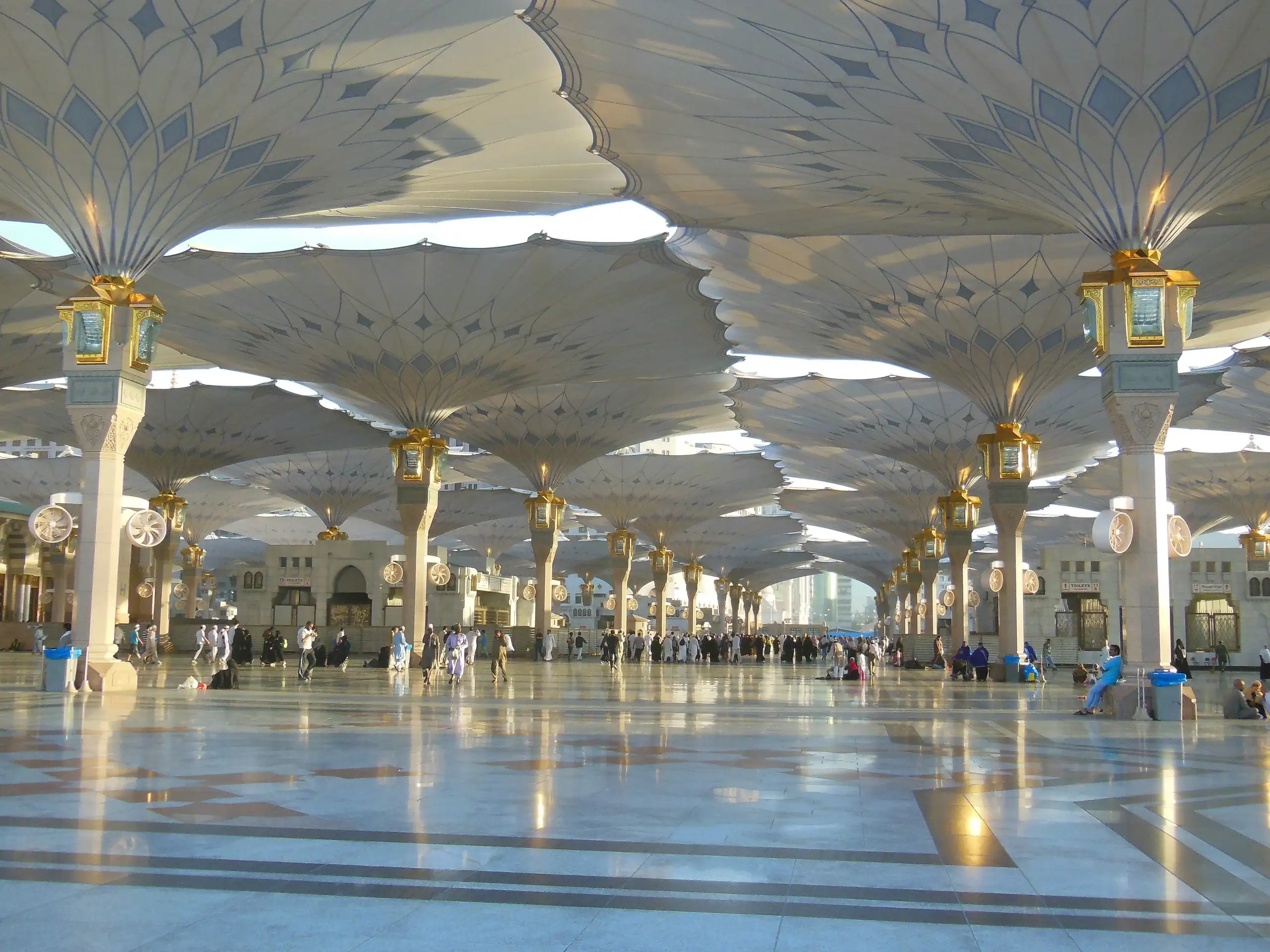
- 262 giant umbrellas shade the courtyards; they open early in the day and close in the evening.
Friday sermon translation
The Friday sermon is translated live on FM radio:
| English | FM 105.5 |
| French | FM 99.5 |
| Turkish | FM 107 |
| Urdu | FM 105 |
| Persian | FM 107 |
| Malayalam | FM 99 |
| Hausa | FM 107.3 |
Parking
Underground car parks surround the mosque on all four sides: 24 units of about 184 cars each, with spaces for people with special needs. You can pay at 48 machines or in the Mawgif app. Fees:
- 1st and 2nd hour: SAR 1 per hour
- 3rd to 8th hour: SAR 2 per hour
- From the 9th hour: SAR 3 per hour
Fees can change.
Phone numbers
| 937 | Medical consultations |
| 911 | Emergencies and security |
| 1966 | Guest Care Center, from inside Saudi Arabia |
| 920002814 | Ministry of Hajj and Umrah, from outside Saudi Arabia |
Gate use and routes can change at busy times: follow the signs and staff instructions.
Related guides
Frequently asked questions
How many gates does Masjid an-Nabawi have?
100. The mosque gates are numbered 1 to 42 with letters A–E; the courtyards also have service-building gates (201–236) and outer gates (301–370).
Which gates are for women?
The women’s prayer areas are reached through north gates 23–27 and east gates 28–31 (north-east area), and north gates 15–17 and west gates 11–14 (north-west area). Named women’s gates include 13, 17, 25 and 29.
Do I need a permit to enter the Prophet’s Mosque?
No. Only praying in the Rawdah needs a booking in the Nusuk app.
Where can I get a wheelchair?
Wheelchairs are lent free from the offices near outer gate 344 (east) and outer gates 308–309 (south).
How much is parking at the Prophet’s Mosque?
SAR 1 per hour for the first two hours, SAR 2 per hour from the 3rd to the 8th hour, and SAR 3 per hour from the 9th hour, according to the ministry guide; fees can change.
Where is the Rawdah in Masjid Nabawi?
Inside the Prophet’s Mosque. Entering the mosque needs no permit, but praying in the Rawdah needs a booking in the Nusuk app. Men enter through the visitor gathering point in the southern courtyards; women through the south-eastern courtyard next to facility 201 and courtyard gate 367.
Does Masjid Nabawi close at night?
No. According to Nusuk, the Prophet’s Mosque is open to everyone, 24 hours a day, without a permit. Only the Rawdah needs a booking.