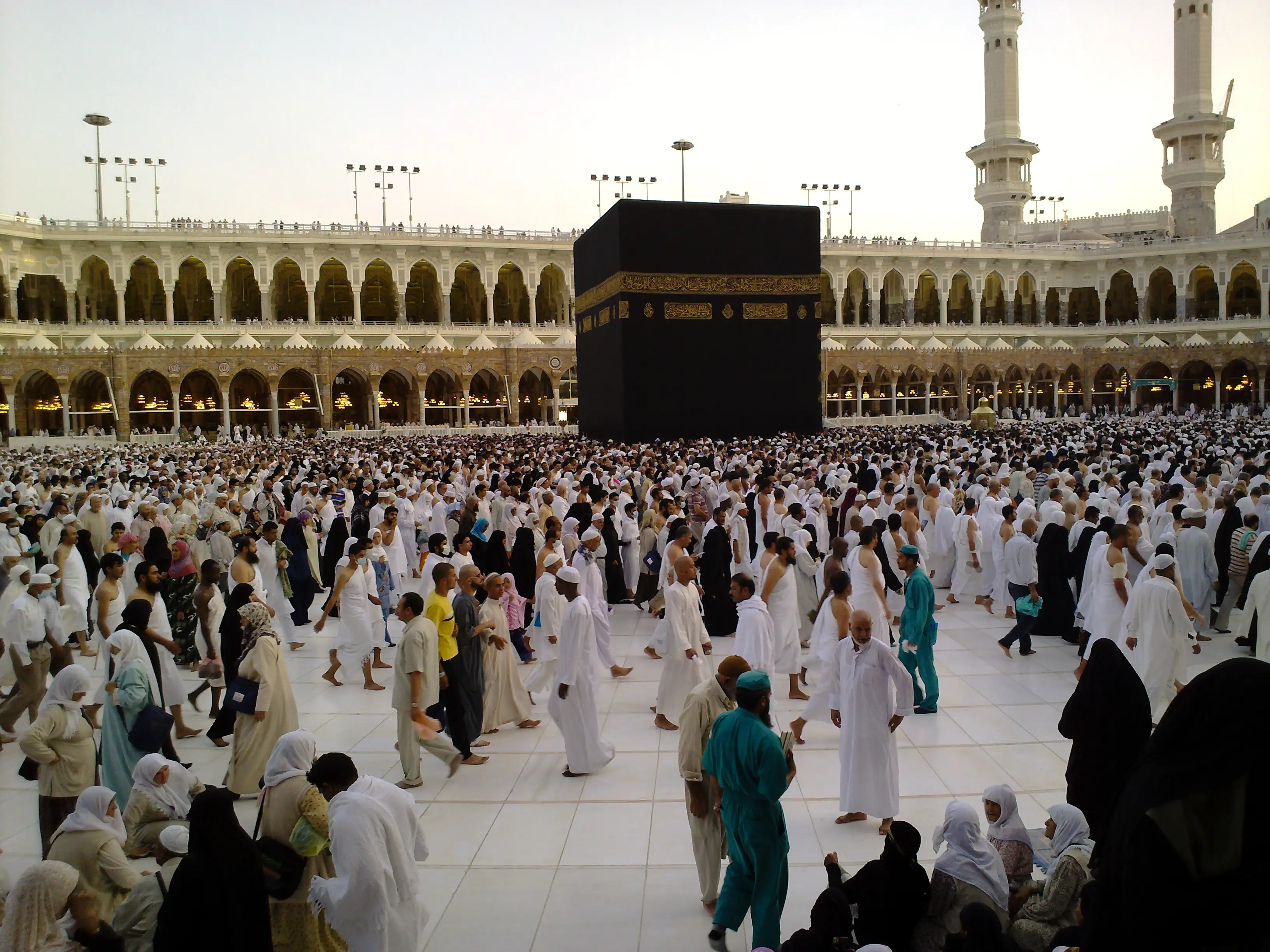
What is inside the Kaaba?
Inside the Kaaba there are three wooden pillars holding up the roof. The interior is not open to the public: only specific people may enter it. This page gathers what the Saudi authorities have published about the interior, the yearly washing, the dimensions and the Kiswa.
Inside the Kaaba
- Three wooden pillars hold up the roof of the Kaaba. Each is made of strong wood, brown tending to black, with a diameter of 44 cm and a circumference of about 150 cm.
- Each pillar stands on a square wooden base carved with engravings and has three rings that strengthen it. The pillars reach the first ceiling, and stacked timbers on top of each one reach the second ceiling.
- A support beam runs between the pillars, with its two ends set in the south and north walls.
- Inside, the distance from the centre of the Yamani wall to the centre of the Levantine wall is 10.15 m, and from the centre of the eastern wall to the centre of the western wall is 8.10 m.
Can you go inside the Kaaba?
- Entry depends on conditions and is limited to specific individuals. The Kaaba cannot be treated or entered like a public site.
- The Kaaba has custodians, the Sadanah, also called al-Hajabah, who inherited its key; the key is held by the eldest of them, and they are informed when the door is opened for cleaning or visits.
- Until the nineteenth century the Kaaba was open to visitors on specific days of the year, one day for women and one for men, each separately. It is no longer open for general entry, to prevent overcrowding, because the number of Hajj and Umrah performers has grown greatly; the Mataf holds about 107,000 people an hour.
The yearly washing of the Kaaba
- The Kaaba is washed every year in the month of Muharram. The ceremony is presided over by the Custodian of the Two Holy Mosques or his representative, with senior officials and state guests attending.
- The walls are rubbed from the inside with pieces of cloth moistened with Zamzam water mixed with rose water; the mixture also includes oud oil, rose perfume and amber.
- An electric ladder 4.80 m high, 5.65 m long and 1.88 m wide is used, with tools made of copper, and four straw brooms with silver handles clean the walls.
Outer dimensions
- The distance from the Levantine corner to the Western corner is 9.90 m, and from the Yamani corner to the Western corner 12.04 m.
- From the Black Stone to the Yamani corner it is 10.18 m, and from the Black Stone to the Levantine corner 11.68 m, which includes the door of the Kaaba.
The Kiswa, the cloth that covers the Kaaba
- The Kiswa is changed each year on 1 Muharram by the General Authority for the Care of the Grand Mosque and the Prophet’s Mosque, with a team from the King Abdulaziz Complex for the Holy Kaaba Kiswa.
- On 1 Muharram 1448 (16 June 2026) a Kiswa made over 11 months in seven stages by 150 Saudi craftsmen was fitted: 47 pieces of black silk embroidered with 30 Quranic verses in silver thread gilded with 24-carat gold, weighing 1,410 kg in total.
- The 1447 Kiswa (26 June 2025) was 14 m high and weighed 1,415 kg. It used about 825 kg of raw silk dyed black, 120 kg of gold-plated silver wire, 60 kg of pure silver wire and 410 kg of raw cotton. The curtain of the door is about 3.30 m wide and 6.35 m long.
Related
Frequently asked questions
What is inside the Kaaba?
Three wooden pillars hold up the roof, each 44 cm in diameter, standing on square carved wooden bases. The interior measures 10.15 m by 8.10 m between the centres of the walls.
Can anyone enter the Kaaba?
No. Entry is limited to specific individuals and depends on conditions; the Kaaba is not open for general entry, to prevent overcrowding.
When is the Kaaba washed?
Every year in the month of Muharram, in a ceremony presided over by the Custodian of the Two Holy Mosques or his representative.
When is the Kiswa changed?
Each year on 1 Muharram. The 1448 Kiswa was fitted on 16 June 2026.
How much does the Kiswa weigh?
The 1448 Kiswa weighs 1,410 kg in total, with 47 pieces of black silk and 30 embroidered Quranic verses. The 1447 Kiswa weighed 1,415 kg.